https://buyercaddy.com/wp-content/uploads/2026/05/18f45c4e-74d5-43bb-9502-f54181a80b1e.png10241536Pawan Nachnanihttps://buyercaddy.com/wp-content/uploads/2023/06/BC_headerlogo-2.pngPawan Nachnani2026-05-07 08:48:482026-05-07 18:54:29Why Workforce Intelligence Is the Next Frontier of Competitive Advantage
Tech Stack Intelligence, Fully Activated in Your GTM Workflows
The BuyerCaddy Technoverse™ has redefined Tech Stack Intelligence. Today, we’re taking it further: fully integrated insideClay. SDR leaders, RevOps teams, and GTM executives can now activate the largest, most comprehensive technographic dataset directly in their workflows — without exports, spreadsheets, or guesswork.
And now, with Tech Stack Benchmarking, teams can see how their tech stacks compare to their peers and competitors — unlocking actionable strategic insights for revenue acceleration.
In an era where AI is only as good as the data behind it, we believe every platform, product, and decision engine needs industrial-grade technographics to compete. BuyerCaddy enables you to see what technologies companies are using — across software, infrastructure, and emerging technologies — so you can build smarter, target sharper, and move faster.
The BuyerCaddy Technoverse™ is the largest Tech Stack Intelligence layer in the market — tracking 170,000+ products across 30 million companies in 50+ countries, now fully integrated inside Clay with benchmarking capabilities and 5x the coverage of legacy providers.
Inside Clay, this intelligence becomes operational. Teams gain:
Precision segmentation
Faster account qualification
Competitive visibility at scale
Tech Stack Benchmarking vs peers and competitors
Context-driven outbound
Tech Stack Intelligence is no longer static. It’s embedded directly where GTM teams execute.
The Category Gap
Legacy technographics were built for a slower era. Modern GTM requires complete stack visibility:
AI-native platforms
Emerging category leaders
Vertical SaaS
Regional platforms
Global stack combinations
Partial visibility creates blind spots — and blind spots cost pipeline. BuyerCaddy Technoverse™ inside Clay solves that — with benchmarking that shows exactly where a company stands relative to peers and competitors.
5x the Coverage. Zero Blind Spots
With 170,000+ products tracked across 30 million companies in 50+ countries, the BuyerCaddy Technoverse™ doesn’t just highlight top enterprise tools — it maps the entire software universe.
Where legacy providers see segments, the BuyerCaddy Technoverse™ sees the full stack. Coverage defines visibility. Visibility defines strategy.
Benchmark Your Tech Stack
Inside Clay, you can now:
Compare your company’s tech stack to direct competitors
Identify tools peers are adopting faster
Spot gaps or over-investments in your own stack
Measure emerging trends in your industry
Benchmarking turns raw data into strategic insight — empowering GTM teams to focus efforts on where they’ll win the most pipeline.
https://buyercaddy.com/wp-content/uploads/2026/02/bcandclay.png10241536Pawan Nachnanihttps://buyercaddy.com/wp-content/uploads/2023/06/BC_headerlogo-2.pngPawan Nachnani2026-02-13 21:38:182026-02-16 18:38:53BuyerCaddy Technoverse™ Comes to Clay
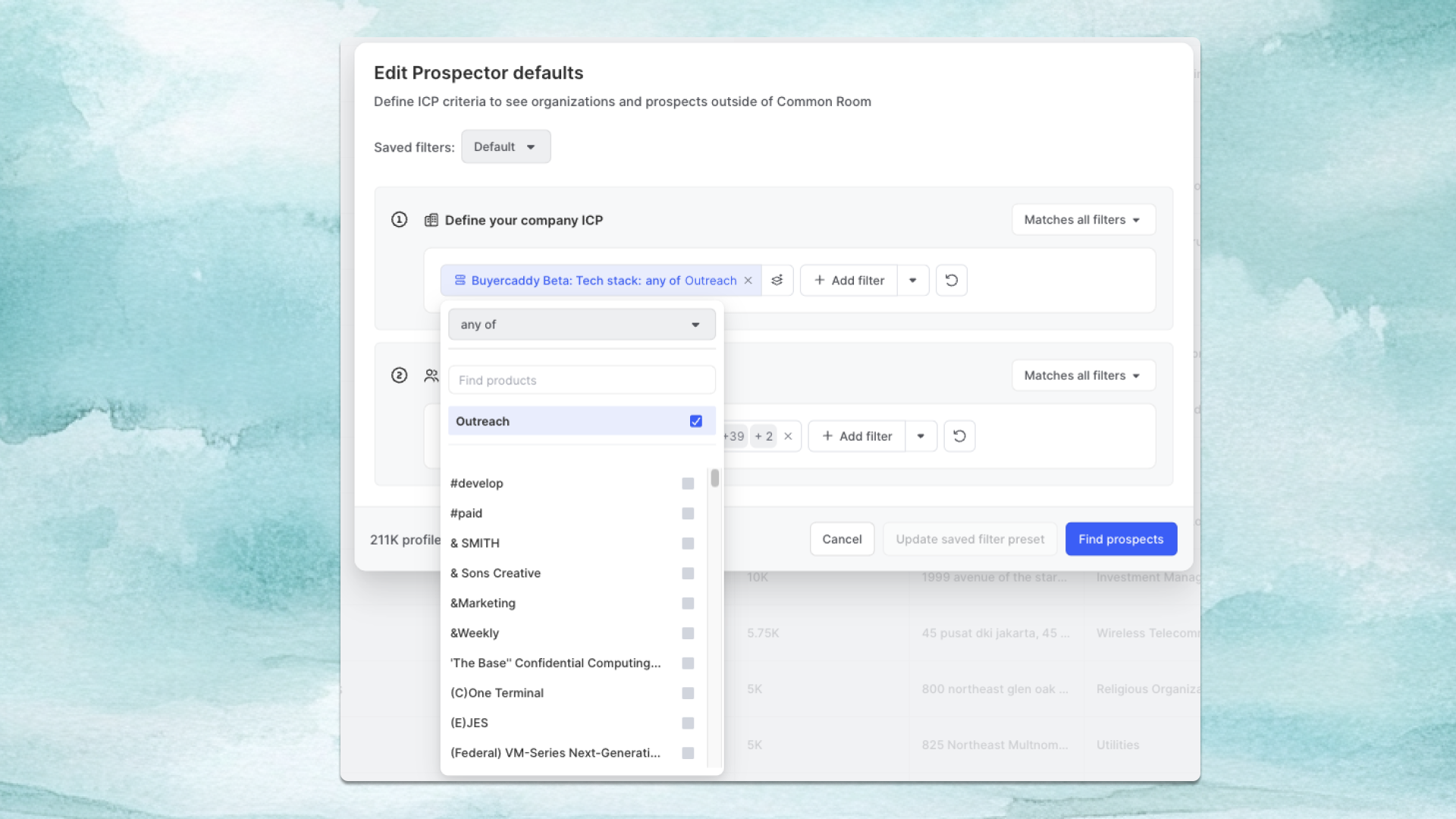
Supercharge your prospecting and account research with enhanced technographic insights: Common Room’s partnership with BuyerCaddy leverages incredible breadth and depth of technographic signals.
Technographic signals include niche signals for precision targeting: installed technologies and vendors, when an install occurred, and how many verified installs we can identify (intensity).
Action on technographic signals in a number of different workflows: Run competitive displacement plays, build dynamic segments to define your ‘best fit customers,’ and understand the tech stack maturity of your accounts for more precise scoring and prioritization
Common Room helps GTM teams act on the signals that actually move revenue, who is engaging, what they care about, and where momentum is building. Under the hood, that only works when you have a trustworthy identity foundation, so every signal rolls up to the right person and the right account, in real time.
Today we’re excited to announce the evolution of prospecting with Common Room that augments our best-in-class signals with refined technographic insights via our partner, BuyerCaddy.
This means you can now identify, segment, score, and orchestrate outreach based not only on who is showing intent, but what technology they use, when they installed it, and intensity of utilization.
The result is: tighter ICPs, sharper plays, better timing, and more pipeline with less guesswork.
The problem: “the right accounts” still feel fuzzy
Most teams can name the kind of companies they want (cue: “I’d love to have that logo” from execs.) However, we recognize that it’s harder for teams to reliably answer questions such as:
Which target accounts are already running the stack we integrate with?
Which accounts just adopted a competitor, or are likely to churn from it?
Which segment is ready for an upgrade, based on stack maturity?
Where do we actually have white space, and where are we saturated?
Without solid technographic data, you’re left with manual research, stale enrichment, and broad targeting that dilutes messaging. Even worse, your systems drift: scoring models degrade, segments fall out of date, and reps lose confidence in the “why now”.
1) Technographic signals, built into Person360 and prospecting workflows
Common Room is built on Person360, our dynamic identity layer that unifies signals, interactions, and identities into a single universal profile, so teams can take action with confidence across sales and ops workflows.
With Common Room Prospector, technographics become first-class signals in that same system of record:
Installed technologies and vendors
Time signature of install (when it likely appeared)
Intensity (how many verified installs we can see)
Additionally, we make sure that technographics are living inputs into segments, scoring, and orchestration into sales plays as opposed to one-off spreadsheet exercises.
2) Technographic coverage at the scale contemporary GTM needs
Our partnership with BuyerCaddy brings the following technographic coverage into Common Room:
180,000 products
92,000 vendors
31 million companies across 50 countries
10+ years of history
Mapped to G2 taxonomy
BuyerCaddy’s approach is built to detect new products in real time, with expansive product coverage that helps teams avoid blind spots by using a combination of large-scale processing and continuous web discovery:
LLM-based processing across 1B+ resumes, professional profiles, and job postings that uses specialized Name Entity Recognizer (NER) algorithms to detect products and vendors in unstructured text.
AI agents and human-in-the-loop workflows that crawl web-base sources including case studies, white papers, press releases, developer forums, and even logos from vendor websites to find and process customers of a new product in real time.
Okay that’s great, how can I actually use this?
Below are the most common ways teams will use technographic signals inside Common Room, mapped to workflows we see across Sales and Ops.
1) Tighten your ICP and TAM with evidence, not assumptions
Use case: TAM / ICP exercises
Workflow: Build dynamic segments of accounts that match your “best fit stack”, then compare against your current pipe, customers, and whitespace.
How this works with Common Room:
You can define ICP attributes based on actual tech adoption, not proxy firmographics.
You can run “what percentage of our pipeline matches ICP stack criteria?” in minutes.
You can keep segments continuously updated as companies adopt new tools.
2) Run competitive displacement plays with timing and precision
Use case: Competitive product displacement campaigns
Workflow: Identify the subset of accounts that installed a competitor, or show stack patterns that suggest vulnerability, then launch multi-touch plays across sales and marketing.
How this works with Common Room:
You can detect adoption signals earlier, and segment faster.
You can tailor messaging to the account’s current reality, including their likely toolchain and maturity.
You can prioritize accounts where the “switch story” is strongest.
Outcome: higher reply rates, more meetings from the same outbound volume, better win rates against competitive deals.
For Sales: better prospecting and account engagement
The job is harder than ever: personalize at scale, multi-thread into unknown buying groups, and generate predictable pipeline. The reality is fragmented tools, shallow insights, and data that goes stale.
With Common Room, technographics enhance the workflows sales teams already run in Common Room:
Account development and multithreading: identify the right stakeholders, then engage with context that matches the account’s environment.
Inbound engagement: qualify and route faster with technographic context alongside engagement signals.
What sales teams get: higher inbound conversion, more efficient outbound execution, deeper account engagement, more predictable pipeline.
For RevOps: stronger guardrails with less manual work
Ops teams are asked to create systems that scale, without slowing the business down. But manual workflows pile up, CRM trust drops, and scoring models degrade.
With Common Room, technographics become a durable input for:
Continuous data hygiene: cleaner records and better alignment across systems.
Dynamic scoring and segmentation: always up-to-date targeting without constant rebuilding.
Sales play development: better guardrails for “who to reach, when, and why”.
Workflow orchestration: fewer brittle rules, more confident automation.
What ops teams get: better funnel conversion, more scalable plays, reduced operational overhead.
Why this matters: signals are only useful when you can act on them
Technographic data is not new. What’s new is making technographics actionable in the same system where your GTM teams already prioritize, route, orchestrate, and execute.
Common Room’s offer enhanced technographic signals in our GTM execution platform so you can go from “interesting” to “in motion” with far less friction.
This is great, now what?
Enhanced technographics are available now, no change on your side needed. If you’re already using Common Room, your team can start building technographic segments and plays immediately. If you’re new, we’ll show you how Common Room’s Prospector fits into your prospecting, scoring, and orchestration workflows end to end.
If you’re ready to start, book a meeting and we’ll walk through:
Understanding which technologies your prospects use can be the difference between a cold outreach and a perfectly timed conversation. Studies show that technographic data increases lead conversion rates by up to 40% compared to demographic data alone. Yet most sales and marketing teams struggle to access reliable technology intelligence without expensive enterprise contracts or complex integrations.
Databar.ai is thrilled to announce a new strategic partnership with BuyerCaddy, integrating BuyerCaddy’s comprehensive technographic data directly into the Databar.ai platform. This collaboration is set to revolutionize how marketing and sales teams build and maintain their most valuable asset: a precise, data-rich B2B database.
The Power of Partnership
In a market saturated with “all-in-one” solutions, the demand for best-in-class data has never been stronger. This partnership embodies that principle, combining Databar.ai’s powerful data automation capabilities with BuyerCaddy’s proprietary, high-quality tech stack data. By bringing the world’s most extensive technographic dataset directly into Databar.ai, we empower users with a “batteries included” experience, unlocking superior insights without the complexity of traditional data integrations.
“We’re excited to partner with Databar.ai to make our comprehensive technographic intelligence more accessible to sales and marketing teams. This integration allows users to leverage the power of technology data through an intuitive platform that eliminates traditional barriers to accessing enterprise-grade insights,” said a spokesperson from BuyerCaddy.
“BuyerCaddy’s focus on technographic accuracy and comprehensive coverage makes them an ideal partner for Databar.ai. Their dataset spanning 90,000+ products across 20 million companies provides our users with the technology intelligence they need to identify prospects, understand competitive landscapes, and time their outreach perfectly,” said David Abaev, Co-Founder & CEO at Databar.ai.
Key Features of the Integration:
Enriched Company Profiles: Seamlessly append BuyerCaddy’s technographic data to your existing contact lists.
Intelligent Lead Scoring: Identify and prioritize leads based on their current technology stack, a key indicator of buying intent and product fit.
Total Addressable Market (TAM) Analysis: Accurately build and analyze TAMs based on specific technology usage, allowing for precise market share analysis and competitive intelligence.
Real-time Insights: Access real-time adoption signals across key technologies to stay ahead of market trends and time your outreach perfectly.
Targeted Audience Segmentation: Helps go-to-market teams create more specific and precise audience segments by identifying companies that are using a particular technology or product.
Competitive Intelligence: Allows for visual benchmarking of a company’s technology stack against its competitors. This helps sales and marketing teams identify competitive install bases and target displacement campaigns.
Predictive Lead Scoring: Enables businesses to score and prioritize organizations that are likely to be in the market for a new technology, based on real-time adoption signals and their existing tech stack.
Market Share Analysis: Provides the data to perform market share analysis of specific product categories or competitors.
IT Asset Management: Assists in managing and understanding the technology assets within a company, including identifying redundant or obsolete data.
Product Innovation: Helps businesses identify emerging technologies and trends to inform the development of new and innovative products.
How it Works
The integration is designed for simplicity and power. Users can navigate to the BuyerCaddy integration in the Databar.ai catalog, connect their data, and run workflows to enrich their databases. The platform handles the complexity of data matching and normalization, allowing users to instantly gain insights that would otherwise take hours of manual research.
This synergy between Databar.ai’s workflow automation and BuyerCaddy’s data provides a seamless, powerful solution that turns raw data into actionable intelligence, helping our users’ customers grow faster and more efficiently.
Ready to leverage technology intelligence for your sales and marketing efforts? Getting started with BuyerCaddy through Databar.ai is straightforward.
Access the technology search interface where you can specify the technologies you’re researching & select the specific technologies you want to analyze
Click ‘Save’ & ‘Run’ and watch your technographic insights populate automatically
Export enriched data with comprehensive technology profiles for your prospects
From there, you can analyze technology adoption patterns, identify prospects using complementary tools, and download enriched contact lists for immediate use in your sales and marketing campaigns.
For more information about Databar.ai and its data enrichment capabilities, visit databar.ai. To learn more about BuyerCaddy’s technographic intelligence, visit buyercaddy.com.
Summary of BuyerCaddy
The BuyerCaddy Technoverse is a data and intelligence platform designed to help businesses, particularly in B2B sales and marketing, to more effectively find and engage with their target audience. Unlike a standalone product, it positions itself as an “ingredient brand” that provides high-quality, foundational data to be integrated into a user’s existing systems and workflows.
The platform is built on an extensive dataset that includes over 90,000 products, 20 million companies, in over 50 countries. It uses this data to provide a comprehensive view of a company’s technology stack (technographics).
Summary of Databar.ai
Databar is a powerful prospecting and enrichment platform that helps teams build targeted lead lists and automate their outreach workflows. By combining 100+ best-in-class data providers with intelligent automation capabilities, Databar enables sales teams to identify, research, and engage with prospects at scale. The platform seamlessly integrates with popular sales and CRM tools, making it easy for teams to maintain a steady flow of high-quality leads. Built for modern sales teams, Databar empowers users to spend less time on manual research and more time on meaningful conversations with potential customers.
Ready to access enterprise-grade technographic intelligence? Get started with BuyerCaddy inside Databar today!
https://buyercaddy.com/wp-content/uploads/2025/09/image.png10801920Pawan Nachnanihttps://buyercaddy.com/wp-content/uploads/2023/06/BC_headerlogo-2.pngPawan Nachnani2025-09-18 17:38:022025-09-18 17:43:32Fueling AI Workflows with Best-in-Class Data: Databar.ai Partners with BuyerCaddy
Right now, from talking with our customers, we know that finance departments are starting to look at 2024 budget proposals. And, we have also heard that, since every recession in the last 20 years has been preceded by interest rates plateauing – and interest rates started to plateau this last June – this year’s financial year’s planning process will be especially challenging.
BuyerCaddy’s customers are now taking a more cautious approach due to the current economic climate, being conservative with spend and are carefully evaluating all new spend and investment requests. Our customers are also encouraging their business unit stakeholders to explore internal alternatives for cost savings and optimization before considering new purchases.
“One of the biggest pain points among customers we work with is simply lack of visibility to all the tools their company has in its technology stack, to determine what’s not needed and, also importantly, determining critical pieces that may be missing. As a leader, I have personally experienced this struggle. Our mission at BuyerCaddy is to alleviate that frustration. Your tools should be easily identifiable, with seamless integration through your environment to drive productivity, and planning.” – Craig Harris, CEO and Founder of BuyerCaddy.
In fifteen minutes, BuyerCaddy can provide you with a complementary account and analysis of where there may be redundancies or gaps in your tech stack to facilitate your budget planning process.
Set up groups of peer and competitor companies for comparison.
Tap “Insights” to see what’s working, redundant, or what’s missing from your tech stack.
That’s it! In 15 minutes, you’ll have a snapshot of how your tech stack compares to that of your peers and competitors. This comparison will objectively highlight any gaps and potential areas where your company may be falling behind similar businesses.
Armed with this valuable insight, you can prepare for your annual budget planning in a fully informed manner. Over the next few weeks, we’ll share more tips and tools to help you prepare for 2024 and beyond.
https://buyercaddy.com/wp-content/uploads/2023/07/Blog_FI_BudgetPlanning.png12573034Pawan Nachnanihttps://buyercaddy.com/wp-content/uploads/2023/06/BC_headerlogo-2.pngPawan Nachnani2023-07-28 07:38:402025-09-17 21:00:52Start 2025 Budget Planning with Best Practices Benchmarking from BuyerCaddy
“There is already a tool that does something similar”
“I need this so much I bought my own license”
I hear the audible chuckle or groan from those of you that are in Enablement, Operations, or the broader go-to-market (GTM) team. How many times within a week or even DAY do we have these types of conversations around the need for tools?
Technology is essential to the success of any GTM program for consistent, repeatable performance. You know you need it; the reps or other individual contributors demand it. But is a new purchase the only way to go? Without a clear picture of all the tech currently in play, companies can fall into the trap of accumulating tools on the shelf – like a once favorite toy pushed to the back of a closet to collect dust.
No matter the business size, we all experience tech stack sprawl and frustration. It ranges from well-intended individual contributors who snap up on-demand “freemium” tools to go faster, to business units that launch a new tool for a specific, siloed need. IT and Operations are then often left to play catch-up as they try to drive compliance, adoption, and cost containment across the company.
“Go clean your room!”
How do we reconcile an organization’s seemingly disparate software needs and use cases? One way is to conduct and maintain a software asset inventory. I know, I know – that sounds about as appealing as being told to go clean your room. But an inventory can yield huge benefits that make it worth the effort:
Alignment: visibility to current tools across all teams
Reduce friction: clarity for what tools are used where in the business and why
Accelerate Roll Out: speed up program roll out and adoption by leveraging existing tools vs. going through a new purchase
Identify gaps: understand where there are gaps and lack of technology
Savings: reduce risk and cost of duplicative tools
“Ok, fine, but where do I start?”
Creating your inventory will be a team sport. Here are a few tips for getting started:
Steering Committee: Bring together a cross-functional group to get all of your technology cards on the table. This should involve internal customers, administrators, and facilitators of your tech stack like IT business systems, operations, program management, enablement, sales and services leadership, and of course users. Try to keep your crew to about a dozen and identify roles for everyone involved, especially the role of a committee driver to keep momentum.
Gather User Feedback: Next, you’ll want to hear from your end users. One way to gather that is by an anonymous survey to increase the likelihood of candid feedback. Ask questions about the most / least used tools, favorite tools, challenging tools, and wish list. “Ride alongs” or shadowing are also great ways to understand what the team is using.
Data, Data, Data: In addition to anecdotal input, you’ll want to gather objective data from the tools you are using today. Most tools in your tech stack will have a way to run reports to show usage, adoption, and activity to help you determine utilization. Your vendor success manager can also assist here.
Renewals: Last but not least, you’ll want to capture contractual data on the tools in your tech stack. This should include the tool, owner, renewal date, seat count, term, and cost.
Categories on your inventory artifact or spreadsheet will likely end up looking something like this:
Tool | Owner | User Rating | Industry Rating | Seats Allotted / Used | Adoption Rate | Renewal Date | Annual Cost
“Great! Now what?”
Once your inventory is complete, you can breathe a little sigh of relief and take a victory lap. The output of this exercise will provide a clear view of what is currently in the tech stack, highlighting gaps or overlaps.
Now, the hard part. Keeping the inventory current! The key here is making it an active resource for your business. Identify an owner, share it across the organization, leverage it in your software decision-making process, and add or remove tools needed. This will require discipline but will help you maintain momentum toward attaining those benefits previously mentioned.
Good luck with your inventory journey! Let us know how it goes!
https://buyercaddy.com/wp-content/uploads/2023/07/SoftwareAssetInventory-e1689872939972.png4971200Pawan Nachnanihttps://buyercaddy.com/wp-content/uploads/2023/06/BC_headerlogo-2.pngPawan Nachnani2023-07-20 10:45:372023-07-20 10:46:48Everything you need to know about software asset inventory
In today’s rapidly evolving business landscape, enterprises are heavily reliant on technology to drive growth, efficiency, and competitiveness. With the constant emergence of new tools, platforms, and applications, many organizations find themselves with a complex and fragmented technology stack. This article explores the importance of rationalizing your enterprise technology stack and provides insights on how to effectively streamline and optimize your technology infrastructure.
Introduction
Technology plays a pivotal role in driving the success of businesses in every industry. From managing operations and enhancing productivity to enabling seamless customer experiences, organizations depend on an array of tools and systems to support their day-to-day operations. However, as companies grow and evolve, their technology landscapes often become convoluted and cluttered, leading to a host of challenges.
Effects of an Overly Complex Technology Stack
A complex technology stack can pose several challenges for businesses. First and foremost, it leads to increased maintenance and support costs. Each additional tool or application in the stack requires ongoing attention, updates, and troubleshooting. This not only strains resources but also incurs significant expenses in terms of licensing fees and support contracts.
Integration
Integration difficulties also arise when dealing with a fragmented technology stack. Organizations rely on multiple systems to perform various functions, and ensuring seamless data flow and interoperability between these systems becomes a formidable task. Data inconsistencies, operational inefficiencies, and limited visibility across the organization can result from a lack of integration.
Scalability
Moreover, a fragmented technology stack can hamper scalability. As businesses expand, they require flexible technology solutions that can easily adapt to changing needs. However, a complex stack often lacks the necessary flexibility, making it difficult to scale operations efficiently and hindering growth opportunities.
Security & Compliance
Security and compliance risks are additional concerns associated with a convoluted technology landscape. Each tool or system presents its own security vulnerabilities and compliance requirements, making it challenging to enforce consistent security measures and regulatory standards across the organization. An inadequate security posture puts businesses at risk of data breaches and non-compliance penalties.
Worker Productivity
Finally, the user experience and productivity within an organization can be significantly impacted by a complex technology stack. Employees often find themselves navigating through multiple applications and systems, juggling different interfaces and functionalities. This not only slows down their workflow but also affects overall productivity and satisfaction.
Conclusion
As businesses strive to stay competitive and embrace digital transformation, the rationalization of the enterprise technology stack becomes a crucial endeavor. By simplifying and optimizing the technology infrastructure, organizations can reduce costs, enhance integration, improve scalability, strengthen security and compliance measures, and elevate the user experience. It is imperative for businesses to evaluate their current technology stack, identify areas for consolidation and optimization, and embark on a rationalization journey that aligns with their long-term goals and objectives. In doing so, they will pave the way for greater efficiency, innovation, and success in the digital era.
https://buyercaddy.com/wp-content/uploads/2023/07/EnterpriseTechStack_3-e1689873095988.png4971200Pawan Nachnanihttps://buyercaddy.com/wp-content/uploads/2023/06/BC_headerlogo-2.pngPawan Nachnani2023-07-14 22:14:552023-07-27 10:55:15Why Rationalizing Your Enterprise Tech Stack is Essential for Business Success